
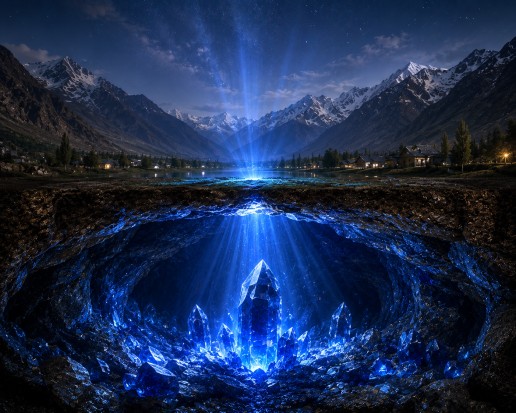
Sapphire, Truth and the Consciousness of a Land
Watch the videos at the bottom on Kashmir, from TRW 2026, that triggered this post
I have been reflecting on something I came across some time ago, and which has returned to me with new force.
There is an ancient and esoteric symbolism around sapphire as a stone of Truth — not simply truth as fact, but a deeper, luminous Truth: something that allows an inner reality to shine through the outer form.
I discovered, in researching this further, that this symbolism has a surprisingly rich lineage. In the mystical interpretation of the Hebrew scriptures, for example, sapphire is associated with Divine Truth that is translucent to inner truth and allows heavenly light to shine through.
In the Indic tradition, sapphire — Neelam — carries another profound layer of meaning through its association with Shani, Saturn. Shani is not merely the planet of difficulty or hardship, as he is sometimes reduced to in popular astrology. He is the force of karma, truth, consequence, discipline, time and justice — the one who brings us into direct relationship with what is real and asks us to take responsibility for what we have created.
And beyond Shani is the consciousness of Mahakaal — the Great Time, the timeless principle that ultimately dissolves everything that is not aligned with Truth.
Seen in this light, sapphire becomes more than a beautiful blue stone. It can be understood symbolically as carrying the light of a Truth that cannot ultimately be deceived or avoided: Truth illuminated by consciousness, tested by time, revealed through karma, and purified through the dissolution of what is no longer true.
This made me wonder about the Earth itself.
Kashmir is one of the world’s legendary sapphire-bearing regions. Sri Lanka is another great sapphire land. And both are lands that have experienced deep and prolonged histories of conflict and social fragmentation.
I am not suggesting that sapphire causes conflict. I have found no scientific evidence for such a claim. Rather, I am interested in holding a more subtle, metaphysical possibility:
What if certain lands carry particular qualities in their geology, and therefore in their symbolic or energetic field?
If sapphire represents Truth — a Truth through which deeper light becomes visible — might a land carrying this quality somehow call the people living upon it into a deeper relationship with truth?
And if that truth cannot yet be held, embodied or harmonised collectively, might the unresolved tension continue to manifest as disequilibrium — fragmentation, conflict, rupture — until a deeper and more integral truth can be recognised and lived?
This is a contemplation, not a theory. But I find the question compelling:
What truth is a land asking its people to embody?
And then I came across something about Kashmir that I did not know, and which makes the symbolism even more intriguing for me.
In Srinagar, on Hari Parbat, is the sacred shrine of Sharika Devi, the presiding Goddess of Kashmir. Sharika is associated with the Sri Yantra / Sri Chakra, and traditional accounts describe the sacred yantra at Hari Parbat as self-arisen and seated upon the rock of the hill.
I have also encountered the claim that the Sharika Sri Chakra is engraved upon sapphire. I have not yet found sufficiently authoritative documentation to establish that particular detail as historical fact, so I want to hold it as a traditional account rather than state it definitively.
But if it is so, the symbolism is extraordinary to me:
The land of Kashmir, a land of profound beauty and profound unresolved conflict, carries the ancient symbolism of sapphire — Truth made translucent to a deeper light — and at its heart, the Divine Mother Sharika in the form of the Sri Chakra.
Perhaps the question is not why the land has so much conflict.
Perhaps the deeper question is:
What Truth is this land asking humanity to learn to hold?
And what would happen when that Truth is no longer merely something we seek, defend or fight over — but something we are capable of embodying together?
— Nilima Bhat
This reflection and its underlying ideas are my own. I have used AI-assisted research to explore references, and AI to help organise and clean up the language; the interpretation and synthesis are mine.



Leave a Reply